
Keep children and pets away and avoid standing directly in the bees’ flight path.
Bee swarm relocation · Antigua
Found bees?
Don’t spray them.
A cluster of honey bees does not automatically need an exterminator. Where it is safe and practical, Old Fort Honey Co. can collect and relocate the colony so the bees have the chance to establish in a managed hive.
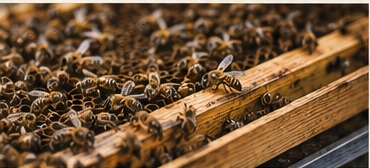
A natural event
A swarm is a colony looking for a new home.
Swarming is part of the natural life cycle of honey bees. A queen leaves an established colony with thousands of workers and they temporarily gather while scout bees search for somewhere new to live.
The sight can be dramatic, especially when a large cluster appears on a branch, fence, wall or roof edge. But an exposed swarm may be temporary and can often be collected without destroying the bees.
Our aim is simple: where a colony can be safely recovered, relocate it into suitable equipment and give it the opportunity to become a healthy managed hive.
What to do now
Give the bees space and send us a photo.
If you can observe the bees safely from a distance, a photograph and a few details help us understand whether it looks like a swarm and what equipment may be needed.
Do not use insecticide, household chemicals, smoke, water or other attempts to disperse the cluster.
Only from a safe position. A wider photograph showing height and access is especially useful.
Send your location, how long they have been there and where the cluster is positioned.
!
If anyone is being repeatedly stung, move away from the area.
Do not approach or disturb a colony that is behaving defensively. Swarm collection is not an emergency response service, and some situations may require additional professional help before bees can be accessed safely.
Our approach
Relocate rather than destroy.
A recoverable honey bee colony is valuable. If conditions allow, we would rather give those bees a hive than lose the colony unnecessarily.
Assess
Photos, location, height and accessibility help us judge whether collection is practical.
Collect
We gather the bees into suitable equipment, aiming to secure the queen and the bulk of the colony.
Relocate
The bees are moved away from the original site and given a suitable hive location.
Establish
The recovered colony is monitored as it settles, builds comb and establishes brood.
Swarm or established colony?
Bees inside a wall or roof are a different job.
A free-hanging swarm is usually much simpler than a colony that has already moved inside a building and constructed comb.
Tree branch or shrub
Fence or post
Roof edge or gutter
Garden furniture
Wall cavity
Roof or ceiling void
Eaves or soffit
Tree cavity
Before you message
Four details help us respond quickly.
You do not need to get close to the bees. Only collect information that can be obtained safely.
Found a swarm?
Send us a photo before reaching for the spray.
Tell us where you are, how long the bees have been there and whether they are hanging openly or entering a wall, roof or other cavity. If the colony can be safely recovered, we will discuss the next step.